

There’s an important distinction between the systems and institutions we are surrounded by: Those that we can reasonably opt-out of, and those that we can’t.
For example, you don’t need a Ferrari to survive. It’s totally fine that Ferrari is a private company. You also don’t need Netflix to survive, so Netflix can continue working just like it always did, if they want to. You get the point.
But what about the following?
Money: Why should random people who are employed by banks and other financial institutions receive any share of my money, even in salaries? The entire financial system must become fully automated, to replace all human intermediaries by algorithms that do the same. Finance, in terms of the procedures needed to run a financial institution, is an exact science. No AI would be needed here at all, it’s simply the ongoing digitization and process automation banks have been trying to realize for decades.
Insurances: Why should random people who are employed by insurance companies receive any share of the money I pay into the insurance? Also insurances must be fully digitized. Just like in banks, people at insurances basically work like a computer anyway, always according to the same rules and regulations. It’ll be a single big effort to finally unify this digitally, and once it’s done, we’d be a big step further as human civilization.
Taxes: Why should random people who call themselves tax “advisors” receive any share of my money? Taxes are defined by laws, i.e. they should always be deterministic, i.e. they should always be realizable in code. Governments won’t do that for us, they’re too dysfunctional for that. That’s why that is actually one of the main projects I’m currently working on, to truly democratize taxes.
Trade: Why should random people employed at or who own shares from companies like Amazon, Alibaba, eBay etc. receive any share of the money I pay to the person/company that’s selling something? Trade (in terms of facilitating seller and buyer finding each other) is a purely administrative task, just like any other, so it can be fully digitized too (also see The Common Market: When I shop online, I support my kindergarten).
Government: Same here, i.e. why should any people receive a livelihood from the taxes we pay, just to keep the administration running? Any administrative system is, again, defined by laws and common practices, which can be digitized like any other administrative unit, as they should be fully deterministic. No humans should be necessary to run the government, because humans only introduce error. Unlike humans, laws are meant to be non-ambiguous.
I think where most digitization efforts have failed so far is that they always only consider one of these aspects at once, but not all of them in their totality.
The higher purpose is simple: make the parts of society that are supposed to work like a clock actually work like a clock — predictable, equal for everyone, and fast, without having to “know someone,” wait weeks, or depend on who happens to process your case. That immediately raises the sensible questions:
Who decides the rules? Same as today — democratically and publicly, not by a vendor or an agency’s internal habits. This idea is not about how to make new laws, rules and regulations, but how to realize the existing ones more efficiently and how to realize modifications of such rules with basically no hassle.
What about edge cases and discretion? Those stay human by design, explicitly marked as such, instead of being smuggled in through arbitrary back-office decisions. The purpose is to always clearly document why a decision was made: Based on clearly specified rules (e.g. the income tax rate when calculating your income text) or based on human judgement?
Who is accountable when something goes wrong? The rule set is versioned, reviewable, and auditable; every decision is traceable to a specific rule, at a specific time, with a clear appeals path.
What about data protection? Data minimization, purpose limitation, and strong encryption become defaults, because the system no longer needs informal access, copy-paste workflows, or “just send me the documents again.”
In other words: where we collectively want outcomes to follow rules rather than moods, the goal is to make that promise real—transparent, verifiable, and boring in the best possible way.
The world is governed by “paperwork”, but not only in the form of physical paper anymore, but also in digital systems. Right now, there is a big divide between these two worlds, and they rarely interact with each other well. But it doesn’t have to be like that.
It would be an effort to finally create complete certainty around the “inner workings” of the institutions that make up a big part of our civilization (primarily governments, banks, insurances, trade). Personal opinions of clerks or decades-old systems handling our data would be replaced by open source code which can always be executed instantly, a single repository for each jurisdiction, and one large one defining all the interactions between jurisdictions. And if the law is not precise enough, it must be made more precise in the regular democratic process until it covers all needed cases. It would be a conscious effort to really start seeing the beauty in law-making, where laws are not just inflexible mysterious spells understood only by people who studied it for a decade, but instead as a driving force for democratic dialogue, accessible to and usable by everyone. Humans should focus on the parts of the law where humans are actually needed, not where the humans deteriorate to mindless manual “computers”.
Of course this needs a fundamentally new data architecture. If we really dream of a system which can perform any administrative task (i.e. everything from handling money, to accounting for banks, to handling insurance claims, to determining tax rates and paying taxes, to all trade between individuals and companies, all directly derived from the underlying laws and regulations), it’s necessary to define clear protocols and schemas for what all these transmission paths and data objects should look like.
As we know, America and China typically stand for more centralization and more surveillance. I believe that we as Europeans have a unique chance here: Creating a truly decentralized system that does this.
The way how I imagine this is that all personal data is securely encrypted before it’s store in this “cloud of our civilization”. You would then only have your private key on a Yubikey or a similar hardware token. The way how you would access this system would be through any channel you want: computers, big touchscreens which form the core part of any city hall, your phone (both the screen and voice-only etc.). You’re always you, so of course you would never need to remember any passwords or even have a password manager in this system, as the components don’t need separate passwords. One purpose would also be to eliminate all barriers which currently e.g. older people face when using digital administrative systems, because, if all administration has been boiled down to a set of functions with clearly defined parameters you can also allow all other types of interface methods, such as voice.
All administrative institutions must be fundamentally non-human (i.e. be fully driven by computer systems). All administration must be transformed into fully deterministic procedures.
Of course humans can still be involved when the law specifically asks for that, for example obviously judges would still be necessary. But by default, no people should work for the government on just realizing the law itself in terms of the associated paperwork, i.e. in the “back office”. Same for banks. I don’t want any human to ever even come close to my money. Banks are just gigantic paper tigers, and all banks could easily be consolidated into one; the end-customer would certainly barely care.
As long as the fate of my money is intertwined with the personal fate of the individuals employed at the bank, or the shareholders of Amazon, or the government clerks, or all the tax advisors, the money system is “dirty”. These people, simply because of their role in the system, can never have a neutral opinion about money, as the inefficiency of the system guarantees their jobs, and they profit while others often need to wait for important documents for a long time. Of course we will need to find completely different jobs for them! It’s millions of people globally who’s only task in life it is to handle “paperwork” (physically or digitally) for individuals, companies, governments and other institutions. This must finally stop. Sitting at the desk all day is deeply inhumane. Humans must run and jump, not sit on a chair being bent over all day, or be in an uninspiring office environment all day.
If we want to take our civilization’s health truly seriously, we must grab the root of all the bug in today’s systems: People doing administrative tasks manually, in any shape or form. Only once we see the big picture here, see the connection from ancient cuneiform to modern “eGovernment”, we can realize: Human civilization is based on keeping registers of stock, transactions etc. Every such action can first be automated on the surface level (e.g. by automating mouse clicks on the screen in your online banking interface), and eventually we go deep and notice: We all have a name. We all have an address. We all have a tax identification number from the government (at least in most European countries). We all have certain ownership, certain contractual arrangements, certain obligations, certain rights etc., which we must all keep track of. It makes a lot more sense to start understanding “ownership of money” as a single, globally understood concept instead of as something which can be, for example in the case of contemporary money or money-like assets, be distributed over different asset classes, across different bank accounts, different technologies (e.g. TradFi/DeFi), etc. This is the big challenge: discovering all existing systems which store anything related to money, and then attaching their APIs or scraping them, effectively doing anything to make them feel like all the others, by “APIfying” them.
Any small business needs to do basically the same when filing taxes. And still, the tax advisor lobby has successfully inhibited all true progress in the sector (as we see with the horrible state of digitization of the tax systems in basically every country, especially when it gets to the more complicated cases), to continue making us believe that their “advisory” would be necessary.
Similarly, any bank is confronted with a similar dilemma, just on a totally different scale: All customer records are stored in the “core banking system”, an often ancient, super expensive and inflexible piece of software. Same for online shop, where Shopify and similar companies have profited a lot from this “everyone’s basically doing the same administrative things anyway”. But why not think further?
The journey of the human race with symbols and writing goes a long way back. Recording especially common knowledge (i.e. states of a system everyone needs to agree on, e.g. whether I have enough money on my bank account or not to buy something) is an important purpose of symbols and the digital systems they construct and are stored in, as the institutions governing these records are those over which wars are fought, as they form a core piece of the contemporary “nation state” and the purpose of the nation itself, as a group of people (and a defined area of land) working together to raise each other’s quality of life.
I think most people will understand this pretty quickly. With the digital tools we have accessible today, together a “humanity united in administration”, this one-time “translation” of all national and cross-border laws and procedures for all administrative institutions (as mentioned in the bullet points above) into code can be done in a collaborative way, globally, across our entire civilization.
It’s an epic project, and I believe humanity is ready to embark on it: Solving the “paper crisis”, as I like to call it, i.e. the currently very dissatisfying state of the world where the realization of many people’s ideas is inhibited by slow-moving bureaucracy. We’ve been walking through the mud for long enough.
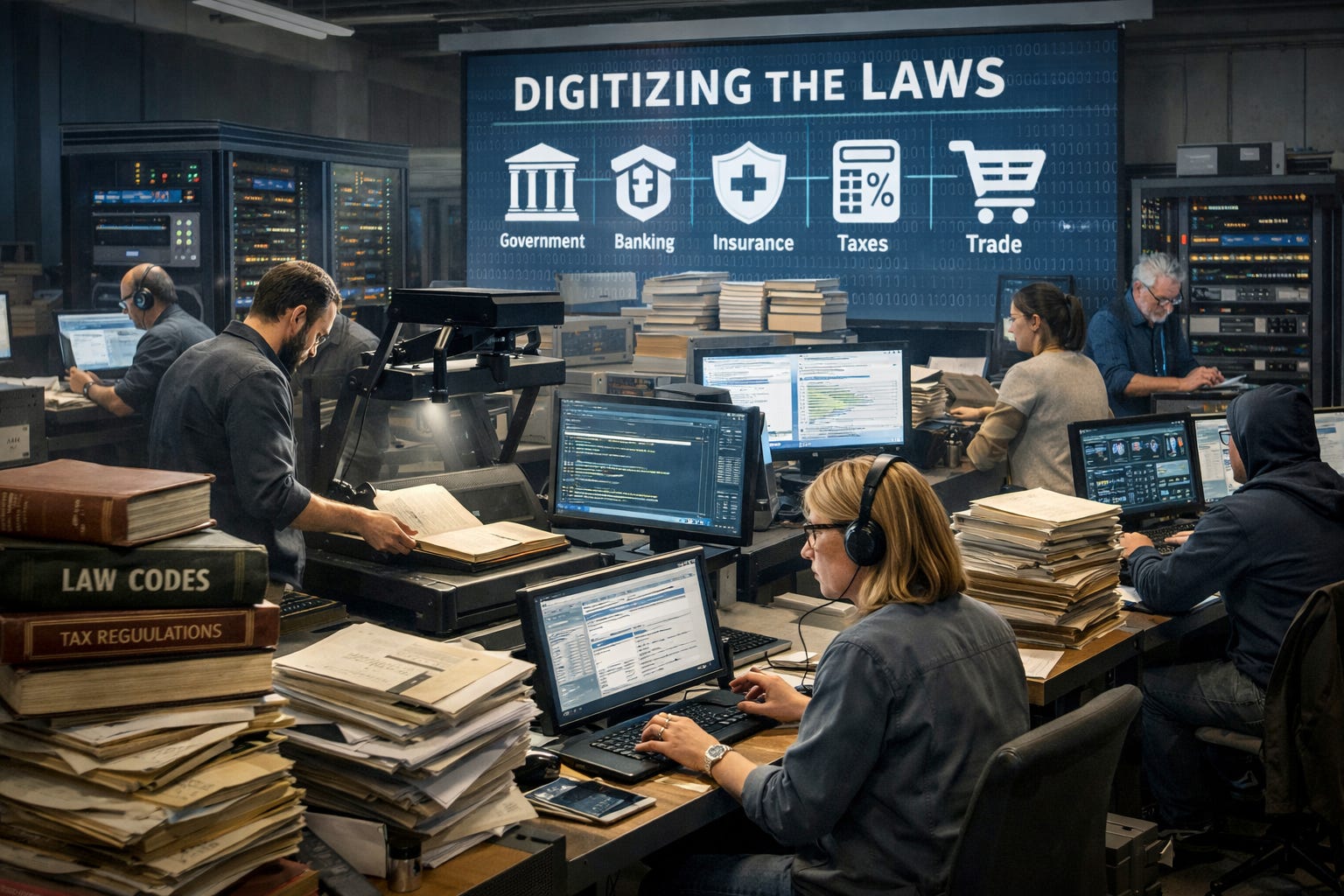
Fig. 1: This would be the scene for a few months or even years in all countries of the world: Reformulating all existing laws and procedures in all administrative units to a shared global standard. (generated with ChatGPT)
As mentioned, we’ll need to be ready for a few million people to be very angry, because they will lose their job. We need to be brave to not be crushed by them, as many of them are the most powerful people in the world, all the way up to the “emperors” (presidents, CEOs, directors, the Big 4 etc.) of their respective “paper empires”. We can be grateful to them for getting the digitization of administration started (as many things can be prototyped well in profit-driven settings), but their reign must naturally come to an end, as we see that they must not be unique. They have brought value into the system by realizing certainly effective institutions, but the “last mile” is now to automate these institutions. Trade is not a “brand”, it’s just the concept of trading things between people, which is globally understood by everyone. Taxes are not “TurboTax” or “ELSTER”, taxes are just taxes, payments to the government, also globally understood by everyone. If you move to a new country, you shouldn’t need to change tax software.
But also the people currently benefitting from our systems of stagnation and inefficiency, whose lives will be disrupted by this project, also they will realize eventually: It’s for their own good. Indeed, it’s for the betterment of the entire world. Never again should any idea be held back by slow bureaucracy, never again. If you can think about it, you should be able to file a form for it and get a decision, not within months, but milliseconds.
The reign of all the artificial complexity, of all the incentives against simplification, will soon come to a close. If we want humanity to grow closer together, we need to seriously abolish administrative burden. It’s not a gradual change, it’s a radical cut, a band-aid to be ripped off once. It’ll be a bit of turmoil for a few years, because all the people in the aforementioned types of institutions will be very confused about how their position, that felt safe forever, could vanish so quickly.
But I think once people are liberated from their desks, liberated from their screens, their Excel spreadsheets and everything surrounding typical “office work”, they will be off to many awesome, much more interesting life journeys, which will benefit the world even more.
It would be the crown jewel project of every person from a Big 4, a government, a bank, an insurance, a startup, or any other unit that does administrative things with the data of customers: Realizing that the existence of this company is futile, and that personal success lays beyond them.
This brings us to the topic of grief.
If this would actually come true in the way how I’m imagining it, people would need to accept a certain kind of grief. After all, many have invested their entire lives into careers at certain institutions. It’ll be almost a “rip” through society. Many people expecting that banks, big trade firms etc. were respected entities suddenly realize that their once beloved idols have been “automated away” by the civilizational insight that it’s nonsensical to leave these systems up to private corporations.
Individual and companies would obviously simply benefit from this: They would see how one day, suddenly, just like a country would switch to a different electrical system, you run on a new frequency. For customers, things would get radically simpler: On your phone, you can uninstall all online banking apps, all apps related to insurances, to online shopping, and every other system whose only purpose it is to store a certain fact about you and for you to perform certain actions in. It would all be combined in a single app for our civilization. It would not be a brand or a company, but an open source community of maintainers, plus the global user base. It’s just humanity, all of us, the app we do our administration with. It doesn’t need slogans or be advertised beyond its initial introduction. It’s infrastructure and it should just work. After the Linux kernel unified all hardware, our civilization’s kernel unifies all software.
I mean, could a few months of very directed work of just a few thousand experts all over the world truly change something? I think it wouldn’t even be so difficult. There are many very low-hanging fruits when it comes to the self-directed, “guerilla” automation of administrative systems. Reverse engineering, scraping or reusing the API behind it is almost always possible, if you have a little bit of experience in that.
You cannot change the world. But at least when you know software engineering, you can reverse-engineer an administrative API, which is the first step towards this kind of “civil disobedience” of “heh, we’ll just automate you away”. First discover the functionality based on reverse engineering, and this will then be the blueprint for the final, eventually beautiful system which serves every function you would expect from a modern civilization in an easy to understand, intuitive interface.
Not only our necks will thank us, but our entire body.
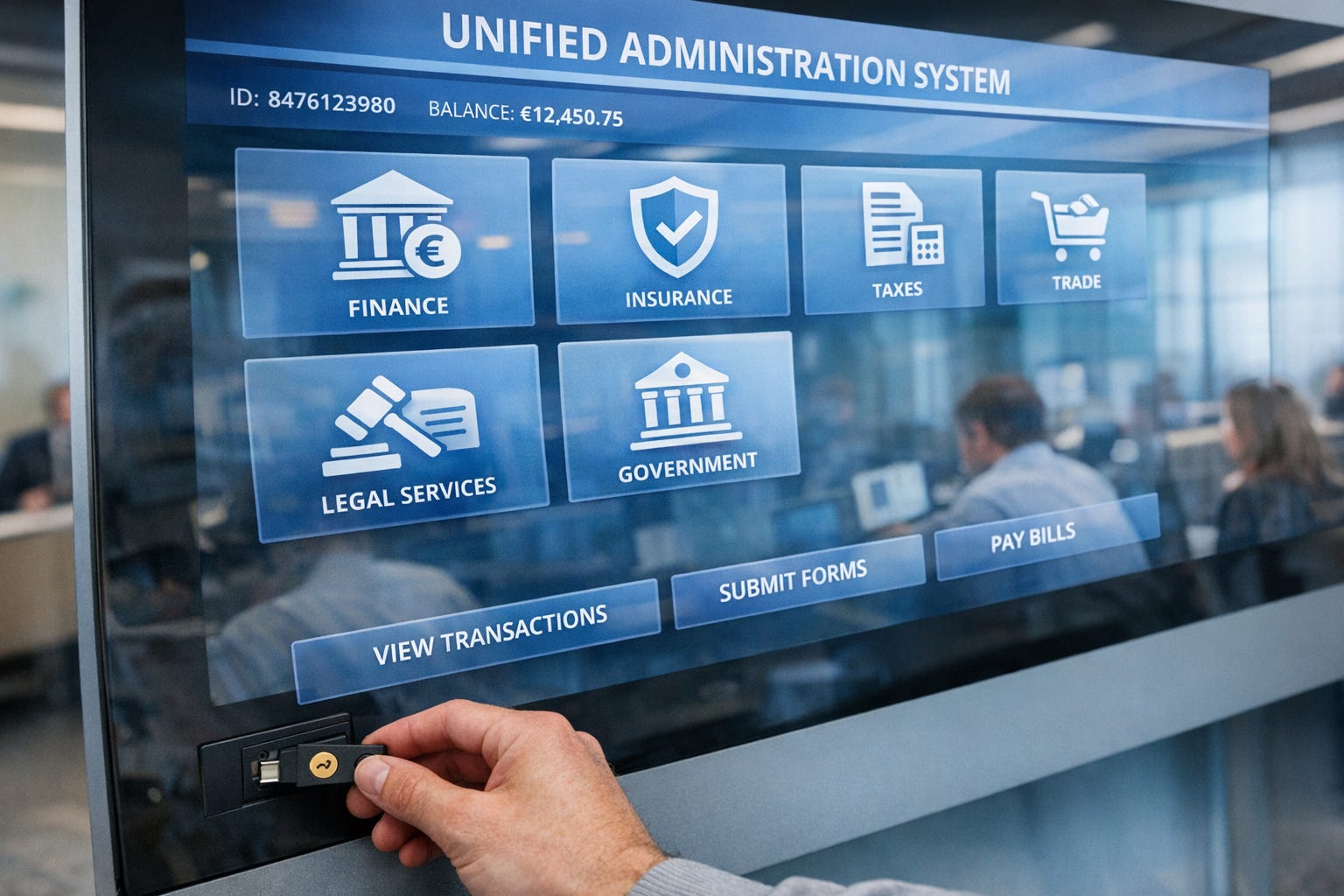
Fig. 2: A mock-up for the “Unified Administration System”. This would be just one “theme”/”skin” for the system; a wide range of skins and ways to access the system would be available. (generated with ChatGPT)